Synonchium caudatubatum


Contents


Rev: 08/20/2026

  Classification Biology and Ecology
Morphology and Anatomy Life Cycle
Return to Synonchium Menu Biology and Ecology
Distribution Management
Return to Selachinematidae Menu Feeding  References
    Go to Nemaplex Main Menu   Go to Dictionary of Terminology

Classification:

Chromadorea
  Chromadoria
Chromadorida
    Selachinematidae
Selachinematinae
       Synonchium caudatubatum Shi & Xu, 2017

    Synonyms:
     

Back to Top

Morphology and Anatomy:

Synonchium caudatubatum  is characterized by:

Females:

  •  Didelphic-amphidelphic, ovaries reflexed
  • Vulva a transverse slit, in posterior half of body length (about 60% of body length).

Ref: Huang and Guo, 2022


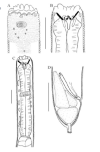
Synonchium caudatubatum. (a, b) Head of male; (c) pharyngeal region of male; (d) tail of male. (Scale bars: 50 um).
(Drawings from  Shi and Xu 2018 via Huang and Guo, 2022)
 

Males:  

  • Diorchic, testes short and broad.
  • Spicules almost straight, with proximal end weakly cephalated, distal end pointed and slightly bent ventrally.
  • Gubernaculum and precloacal supplements absent.
 

Reported median body size for this species (Length mm; width micrometers; weight micrograms) - Click:


Back to Top

Distribution:

Marine nematodes. Reported from intertidal silt sediment in East China Sea

Back to Top

Feeding:

Predatory:on nematodes and micro-invertebrates

Back to Top

Biology and Ecology:


Back to Top

Life Cycle:


Ecophysiological Parameters:

For Ecophysiological Parameters for this species, click If species level data are not available, click for genus level parameters
 
Back to Top

Biology and Ecology:

Predator,

Back to Top

Management:

 
Back to Top

References:

Huang, Y. and Guo, Y. 2022. Free-living Marine Nematodes from the East China Sea. Springer, Singapore and Science Press, Beijing.

Shi, B.Z., and K.D. Xu. 2018. Two new rapacious nematodes from intertidal sediments, Gammanema magnum sp. nov. and Synonchium caudatubatum sp. nov. (Nematoda, Selachinematidae). European Journal of Taxonomy 405: 1-17.
Back to Top

Revised by Howard Ferris. August 20, 2026.