Angusticaecum brevispiculum

Contents

Rev 10/10/2026

  Classification Biology and Ecology
Morphology and Anatomy Life Cycle
Return to Angusticaecum Menu Ecosystem Functions and Services
Distribution Management
Return to Ascarididae Menu Feeding  References
    Go to Nemaplex Main Menu   Go to Dictionary of Terminology


Classification:

Class:    Chromadorea

SubClass: Chromadoria

Order:   Rhabditida

Suborder: Spirurina

Superfamily: Ascaridoidea

Family:  Ascarididae

      Angusticaecum brevispiculum Chapin, 1924

Back to Top

Morphology and Anatomy:

  • Body length up to 120 mm, greatest diameter 3 mm.
  • Head 0.5 mm. in diameter, lips twice as broad at base as high, somewhat rounded.
  • Cuticle transversely striated at intervals of 6um.. Body without alae.
  •  Intestinal caecum slightly more than half length of, and about one-fourth as thick as, the esophagus.
  • Esophagus 6.6% of the total body length.
  • Posterior terminus of body mucronate.
  •  Anus subterminal.
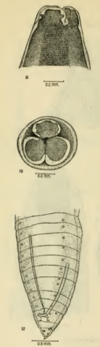
  Angusticaecum brevispiculum  11: lateral view of head; 10: apical view of head; 12: Male posterior
Drawings from Chapin, 1924

Male:

  • Spicules subequal in length (1.4 and 1.3 mm.), one much thinner (28um) than the other (85um.
  • Cloaca about 150 um in front of the posterior extremity.
  • Posterior to cloaca are five pairs of papillae and two single glandular papilliform structures,
  • Anterior to cloaca is a transverse sinuous line of five papillae and, extending anteriorly from the second and fourth papillae of this row are two files, each of 16 papillae,

Female:

  • Vulva a transverse slit just anterior to mid-body.
  •  Vagina about 4 mm. long, uteri double and convergent, reaching nearly to
    posterior extremity of worm, ovaries intricately coiled about the uteri throughout their length.
  • Anus about 1 mm.from tail tip.
  • Eggs 114-142 by 71-85 um with thick smooth shell.

Ref: Chapin, 1924

Reported median body size for this species (Length mm; width micrometers; weight micrograms) - Click:


Back to Top

Distribution:

Species described as an intestinal parasites of the Brazilian large land tortoise, Testuda denticulata.


Back to Top

Economic Importance:


Back to Top

Hosts:

Tortoise, Testuda denticulata

Back to Top

Feeding:

Intestinal roundworm of tortoise

Back to Top

Life Cycle:


Ecophysiological Parameters:

For Ecophysiological Parameters for this species, click If species level data are not available, click for genus level parameters
 
Back to Top

Damage:


Back to Top

Management:


Back to Top

References:

Chapin, E,A, 1924, Nematode parasites of the Brazilian land tortoise, Testuda denticulata. Proc. US National Museum 65(13): 1-8

Back to Top

Revised by Howard Ferris: October 10, 2026.