Parasite of cats and dogs in the southern United States and subtropical
regions of the world, including Central and South Africa, and Southern Asia
(Marchiondo et al., 2020)
Dogs and cats are definitive hosts; hunans may be accidental hosts.
Life cycle direct, no intermediate host involved.
Eggs are passed in feces of infected dogs and cats
(definitive hosts). Larvae develop in eggs and pass through two molts and
hatch in 510 days as the infective L3 (662 um length). Infective larvae are
ingested or penetrate the skin of a suitable definitive host.
Infective larvae migrate to the heart, enter the lungs,
are coughed up and propelled up the respiratory tract and swallowed. They
enter the anterior of the small intestine where they undergo two molts to
the adult stages.
The prepatent period is 14-16 days following infection
(Marchiondo et al., 2020).
Mice can serve as paratenic hosts.
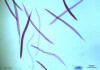 |
Filariform larvae (infective stage) of hookworm. |
Penetration of the larva in humans, which are not the natural definitive
hosts, causes cutaneous larval migrans (�creeping eruption� or �ground
itch�).
Anthelminthics
Marchiondo, A.A. Cruthers, L.R., Reinemeyer, C. 2020. Nematoda, Trichostrongyloidea.
Chapter 2 in Marchiondo, Cruthers and Fourie (eds) Parasiticide
Screening Vol 2. Academic Press
Return to Ancylostoma menu
Want more information about nematodes?
Go to Nemaplex Main Menu.
|