A family of nematode parasites of fish.
-
Oral opening elongated dorsally
-
Esophastome with bilateral symmetry
-
Esophageal lumen reinforced with cuticularized rods
Cucullanus spp are sometimes classified in family
Chitwoodchabaudiidae as subfamily
Cucullaninae. However, the family designation Cucullanidae is more
generally accepted.
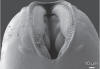
Stomal opening of male Cucullanus epinepheli
(from Moravec and Justine, 2017).
Copepods are intermediate hosts to nematodes of the families Camallanidae,
Cucullanidae, Philometridae, and Anguillicolidae. Life cycle studies of
Procamallanus laevionchus and Paracamallanus cyathopharynx
revealed development of the first three larval stages in the copepod
Mesocyclops leuckarti. Eggs and first stage juveniles contaminate feces
of definitive fish hosts. The eggs and feces are ingested by the copepods.
Larvae in copepods, or other invertebrate intermediat hosts, develop to the
fourth stage and then into adult males and females when ingested by a
suitable definitive host. Larvae ingested by non-host fish often survive as
fourth stage larvae in the gut or other tissues for a variable length of
time and continue development into the adult stage if their paratenic host
carrier host is consumed by a compatible definive host (Ogbeibu et al.,
2014; Petter et al., 1989).
References
Moravec,
F. and Justine, J-L. 2017. Two new species of nematode parasites, Cucullanus
epinepheli sp. n. (Cucullanidae) and Procamallanus (Spirocamallanus) sinespinis
sp. n. (Camallanidae), from marine serranid and haemulid fishes of
New Caledonia. Folia Parasitologica 64:011; doi: 10.14411/fp.2017.011
Okbeibu, A.J., Okaka, C.E., Oribhabor, B.J. 2014.
Gastrointestinal Helminth Parasites Community of Fish Species in a Niger
Delta Tidal Creek, Nigeria. Journal of Ecosystems 2014: ID 246283,
http://dx.doi.org/10.1155/2014/246283
Petter, A.J., Fontaine, Y.A., N. Le Belle, N.
1989. Edute du development larvaire de Anguinicola crassus (Darcunloidea,
Nematoda) chez un cyclopi de la region parisienne. Annales de Parasitologie
Humaine et Comparee, 64:344-355.
Want
more information about nematodes?
Go to Nemaplex Main Menu.