Paracameronia De Carvalho & Spiridonov 1991.
Type species of the genus:
Paracameronia caucasica De Carvalho & Spiridonov 1991.
Synonym:
Characteristics of type species:
|
.
|
Males:
-
Smooth cuticle except on head where
striations are 4 um apart and on tail where they are 10 um apart
-
Lateral alase absent
-
Stoma very small with a refringent ring
at junction with esophagus
-
Esophageal corpus spindle shape, bukb
with valves; excretory pore about 1 body width from head
-
Testis with anterior spermatogenesis
portion and posterior vas deferens
-
Spicule single, 25 um long. Three paira
of papillae, one pair precloacal, the second adcloacal and third
pair on tail
-
Tail relatively large and conical with a
small cloacal protruberance.
Females:
- Generally similar to male.
- Didelphic; vulva at 79% of body length,
- Eggs grouped end to end in uteri and pass through the vagina
in rigid sticks. Eggs with 2 opercula
Ref: De Carvalho and Spiridonov 1991.
|
|
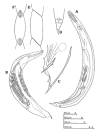
Paracameronia caucasica A: Male lateral; B: Female
lateral; C: Male posterior; D: Mel posterior, ventral; A and F:
Contact between egg shells
Drawings from De Carvalho and Spiridonov 1991
|
| |
|
|
Described from mole crickets (Gryllotalpa gryllotalpa) collected
in South Azerbaijan.
Food Sources and Feeding strategies for the genus Paracameronia
A genus of intestinal parasites of mole crickets
De Carvalho, P.A.F. and Spiridonov, S.E. 1991. Paracamaronia caucasica
gen. n., sp. n. (Oxyurida: Thelastomatidae) intestinal nematode of mole
cricket from Azerbaijan. Nematol. Mediterranea 19:47-49.
Revised by Howard Ferris:
October 22, 2026.