Caballonema Abuladze, 1937
Type species of the genus:
Caballonema longispiculata Abuladze, 1937
Synonyms:
Sinostrongylus
Hsiung & Chao, 1949
List of synonymies per Lichtenfels et al., 1998
Food Sources and Feeding strategies for the genus Caballonema
Intestinal parasites of equids
Species of the Cyathostominae have a direct lifecycle, with no
intermediate host.
Eggs are deposited feces deposited in feces of grazing animals.
Eggs hatch in the feces and larvae develop to the third stage when they
enter an apparent dauer stage surrounded by an extra protective cuticle.
They are able to survive in the grazing area for prolonged periods. In
temperate climates, the nematodes tend to enter the dauer stage during
cooler months while in tropical areas the dauer stage may be entered in the
summer as a protection against heat (Corning, 2009).
After ingestion by a grazing horse, L3 cyathostomins
invade the mucosa of the cecum, ventral colon, or, less frequently, the
dorsal colon. Within 1 to 2 weeks after infection, a fibrous capsule
develops around the larva, which is then termed encysted.
Small-strongyle larvae develop through multiple,
sequential stages. The invading stage (early third-stage larva, or EL3)
grows into a late third-stage larva (LL3), then molts into an early
fourth-stage larva (EL4) and ultimately a late fourth-stage larva (LL4). All
larval growth and maturation occur within the confines of a mucosal or
submucosal cyst. The LL4 stage emerges from the cyst into the lumen of the
large intestine and develops into a reproductive, adult nematode.
Larval development may produce an adult worm within 5
to 6 weeks, or larvae may arrest development in the EL3 stage and not
undergo further maturation for up to 2.5 years. Completing the cycle, eggs
produced by the adult nematodes are deposited in feces (Nielsen et al.,
2014)
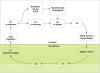
Life cycle of Nematodes of the subfamily
Cyathostominae
Diagram from Corning, 2009
Anthelminthic treatment schedule with rotation of drugs to delay development
of parasite resistance to the medications.
Corning, S. 2009. Equine cyathostomins: a review of biology, clinical
significance and therapy. Parasites & Vectors 2(Suppl. 2) S1 doi: 10.1186/1756-3305-2-S2-S1
Lichtenfels, J.R., Karchenko, V.A., Krecek, R.C., Gibbons, L.M. 1998. An
annotated checklist by genus and species of 93 species level names for 51
recognized species of small strongyles (Nematoda: Strongyloidea: Cyathostominea)
of horses, asses and zebras of the world. Veterinary Parasitology 79:65-79.
Neilsen, M.K., Reinemeyer, C.R. and Sellon, D.C. 2014. Nematodes. Chapter
57 in Sellon, D.C. and Long, M.T.(eds) Equine Infectios Diseases. W.B.
Saunders.
Revised by Howard Ferris:
October 27, 2026.