Ichthyocephaloides dasyacanthus


Contents


Rev 04/23/2026

  Classification Biology and Ecology
Morphology and Anatomy Life Cycle
Return to Ichthyocephaloides Menu   Ecosystem Functions and Services
Distribution Management
Return to Ichthyocephaloididae Menu Feeding  References
    Go to Nemaplex Main Menu   Go to Dictionary of Terminology


Classification:

Chromadorea
Chromadoria


Rhabditida
    Spirurina

                             Rhigonematoidea

                               Ichthyocephalidae

Ichthyocephaloides dasyacanthus Hunt & Sutherland, 1984

The generic name descriptive of the dorso-ventrally flattened anterior region which gives the appearance of a fish head.

      Back to Top

Morphology and Anatomy:

.

  • Cephalic capsule compressed dorsoventrally
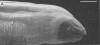
  • Oral aperture slit-shaped, oriented laterally giving the appearance of a flattened fish head with a dorsal and ventral jaw.
  • Four short, conical cephalic papillae
  • Amphid aperturea pore-shaped.
  • Body very long (12-18 mm),
  • Head dorso-ventrally flattened with a wide, laterally orientated, slit-like mouth giving the impression of a fish head in lateral view.
  • Four cephalic papillae, two dorsal and two ventral.
  • Amphidial apertures ventral to the angle of the jaws.
  • Cuticle smooth on head capsule but with transverse rows of minute spines between head and anus.
  • Eesophagus typical of the family, the isthmus being shorter than the height of the basal bulb.
  • Both sexes with long conical tails.

    Female:
     
  •  Monodelphic, reflexed,  with a well-developed vaginal diverticulum.
  • Vagina posterior
Ichthyocephaloides dasyacanthus SEM anterior; bar = 37 um
Photomicrograph from Hunt and Sutherland, 1984

Males:

  • Cuticle smooth
  • Paired spicules, unequal in size

Ref: Hunt and Sutherland, 1984


Reported median body size for this species (Length mm; width micrometers; weight micrograms) - Click:strong>

 
Back to Top

Distribution:

Intestinal parasites in the gut of an unidentified large grey millipede from Bubia ARC, Morobe Province, Papua New Guinea.

Back to Top

Feeding:

  Intestinal parasites in the gut of a species of millipede.

Back to Top

Biology and Ecology:


Back to Top

Life Cycle:

Monoxenous life cycle (i.e. a single host species in the lifecycle).

Ecophysiological Parameters:

For Ecophysiological Parameters for this species, click If species level data are not available, click for genus level parameters

Back to Top

Ecosystem Functions and Services:


Back to Top

Management:


Back to Top

References:


Back to Top

Copyright © 1999 by Howard Ferris.
Revised: April 23, 2026.